I don’t know who was more tired at that point: me or her.
Bedtime is the epic battle of every day. And just when you think you’ve won, when the rustling in the crib stills to naught, you remember the crapload of things you haven’t done and that you only have one hour left to do them all. You accomplish none of them. This is neither win nor lose, but the draw that is (my) motherhood.
Before A Different World, I had no idea what a Historically Black College or University (HBCU) was. I knew that college was a magical place I was expected to attend, but the show presented an image of all-black college Hillman, and I was smitten. The show sealed it in my mind that this was what proper young black women did.
I decided I would go to Spelman College, haven for black girls grown up. The school enthralled me, especially when I discovered that all-male Morehouse was nearby, full of smart, handsome black men.
However, I eventually forgot about my zeal for Spelman and for an HBCU education. When it came time for graduation, my college chose me; I was provisionally accepted into the University of South Florida (USF) early on a full ride scholarship. I applied to no other schools.
I wound up at Florida State University (FSU) for graduate school because their Graduate Studies program sent me an open house flier in my senior year. (Marketing works, ya’ll!) I visited and was wooed by their fellowships. Again, I applied to no other schools, and they accepted me to the Master’s program in English on a teacher’s assistantship.
You haven’t lived until you’ve heard the Marching 100 play.
You cannot live in Tallahassee, Florida, without Florida Agricultural and Mechanical University (FAMU) touching you, even if your feet never grace the University that sits on “the highest of seven hills.” Whether you hear the Marching 100 as you drive down Macomb Street, or the hiss of a Rattler in the middle of Publix, you know that Tallahassee belongs to FAMU as much as it belongs to FSU.
I was asked often why I chose FSU over FAMU and the honest answer is that I never thought about it as an either/or option. FSU advertised and I bit.
Even though I never took a class there, FAMU adopted me. I performed poetry at their State of the Student address; I went on a date to see Alvin Ailey’s troupe dance; I saw Elaine Brown speak; I enjoyed a blue crab and corn on the cob boil on their lawn; I dropped off freshmen to Paddyfote dorms in the dark. FAMU gifted me with the black cultural experience that FSU could not.
Last weekend, FAMU’s football team played Ohio State in a mockery of a game that netted the HBCU $900,000.00 and immeasurably lost pride. The 76-0 loss set records. Football serves as an ambassador for the University; to the millions of Americans who have never beheld the glory of orange and green, this was a shoddy introduction. FAMU was made to look like a bumpkin of a school for the sake of nearly a million dollars–which it needs–but a great image would garner far more income.
But why would FAMU so need the money? Because the school, like many HBCUs, struggles with alumni giving. A confluence of racial politics dating back to the ’60s, graduate dissatisfaction, the new economy, and poor administration are all to blame.
The Numbers Game Photo Credit: Infographic appeared in Jet Magazine Sept 2, 2013
Despite the above challenges, HBCUs still crank out more black graduates in STEM than Predominately White Institutions. Half of the nation’s black teachers, lawyers and judges are HBCU grads. My husband will be an HBCU graduate. My closest friends are FAMUly. Many people lob the asinine question: Does America still need HBCUs? The answer is a resounding yes.
So, because I care that my children experience black teachers and professionals as role models, because I value the historical and ongoing contributions that HBCUs have made to my community, and because FAMU has personally contributed to my development as a black woman:
I am adopting FAMU as my HBCU.
I pledge my support financially. I will give my verbal support, defend the school from spurious attacks as any rightful Rattler would, and challenge its leaders to do right by the alumni and future students.
I repeat, the apt question is not whether HBCUs should still exist. The real question is: How will we ensure that they do?
Sometimes I lie to myself and spin wishful falsehoods about how adventurous I am. I say, Given the chance, I would love to move to Europe or Asia and live for a few years outside the country. I lived in Belgium for a few years as a child since my dad was in the Army, and it completely opened my world.
But for the most part, I am a scared little rabbit. Moving frequently in my childhood birthed a hatred for impermanence. I made friends slowly. And lost them quickly, it seemed, when either their family or mine was reassigned elsewhere across the world. I hated the change of weather, of schools, of people, of myself.
I clutch people and places closely to me because I have never quite shaken the feeling that it’s just a matter of time before I lose them forever. I love the idea of having roots and watching a city grow older with you.
However, I am beginning to wonder if this penchant for treasuring what I love is hindering me from reaching beyond to experience new things. My husband graduates from his PhD program next year and we have been talking seriously about what our future will look like. We are excited; most of our marriage has seen him in grad school and it will be a welcome change.
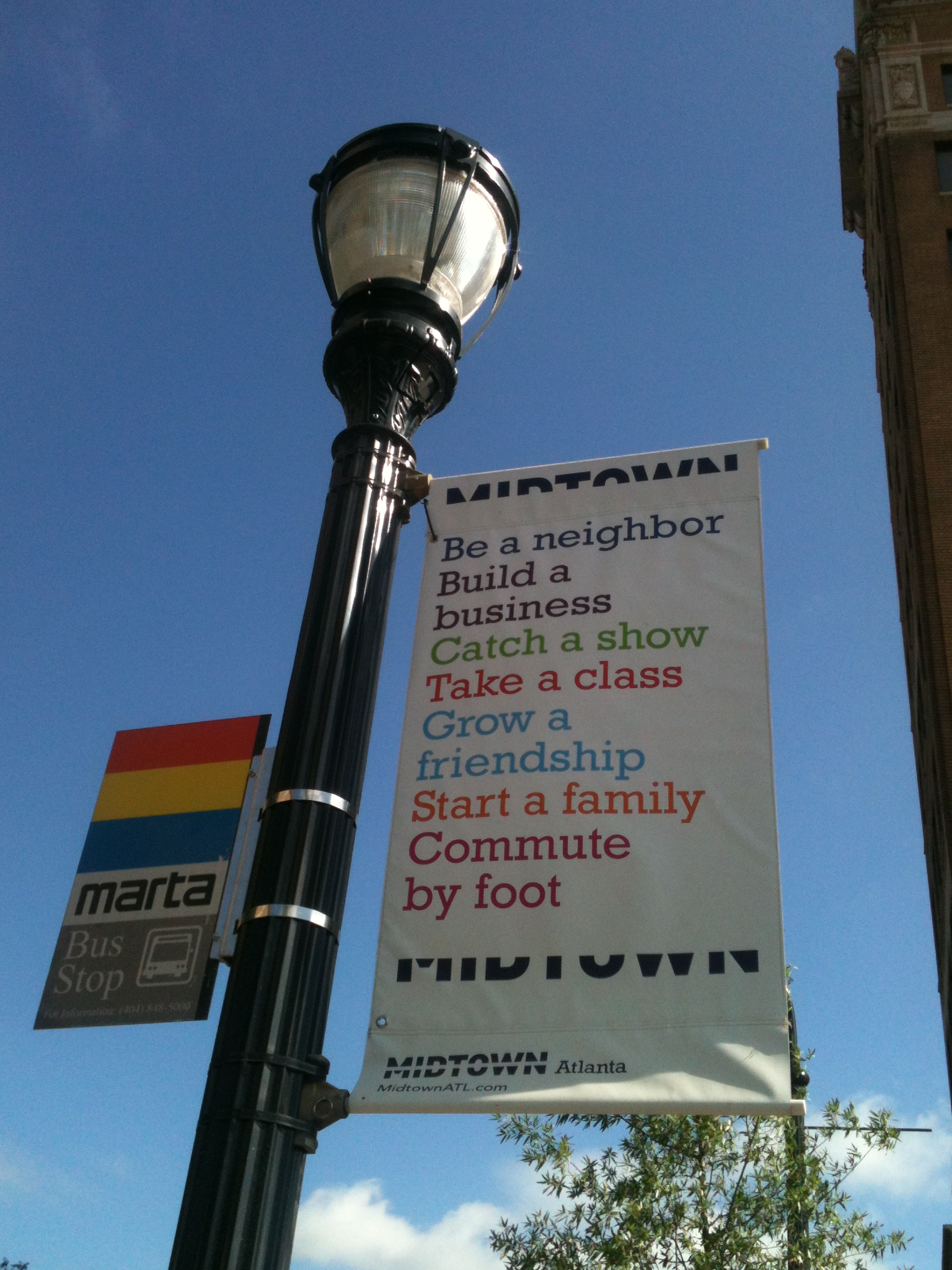
I’ve done all the above in Atlanta and haven’t stopped yet!
Oh, change. I find myself grappling with the idea of us moving. I am alternately terrified and intrigued. I moved to Atlanta the day after my own graduation in 2007. It was my decision to move here and my then-boyfriend joined me. The city hasn’t disappointed me yet. My Instagram feed will demonstrate that I love living here for the diversity, the friendly weather, and because Atlanta always has something new discover.
As a child, I moved because I had no choice: you go where the parents do. This time, I am the parent, the wife, the woman wondering how her life will transform if she packs it up and starts anew.
We’re considering California, Tennessee, New York, Pennsylvania, Ohio, Texas, Florida, Georgia or anywhere he lands a promising position. In my heart, I wonder if I will ever find another city to enchant me like the A. But I also wonder if I am draping my love for location over myself like a security blanket and suffocating the opportunity to be adventurous.
One thing is for sure. There may be little harm in my dislike for the tedium of moving. But I will be vigilant to ensure it does not turn into a dangerous fear of moving on when it’s time to go.
What state are you from or have you moved to? How do you feel about moving to new cities? I welcome any words of wisdom!
My friend Deanna writes a witty point-for-point rebuttal of my post “Why Scandal is Scandalously NOT Great.” I love it! You Gladiators may convert me yet. Bravo, Deanna!
Dara T Mathis, 4’10 of intellectual, natural hair, epic writing awesomeness and my friend of over 20 years has done the unthinkable. In one of our random chats today she mentioned that she has started a mutiny. Over what you might ask? The television show Scandal. Being a Proud Gladiator in a Suit I decided to peruse her recent blog post and see what could possibly be written that would cause a mutiny. I mean me and Shonda are cool. Kerry Washington has been on my Famous People I want to meet list since “Save the Last Dance”, and became a permanent standard in my life since “She Hate Me” Shonda has had a definite hand in making my Netflix subscription worth it over the years. I then embark on reading Dara’s post. In which she lists not 1, not 2 but 6 reasons why she is underwhelmed with Scandal.
Sometimes fear is the four-letter F word. Red and blue lights flash in my rear view and my pulse quickens. I glance over to make sure my glove compartment box is still there, as if, at the sound of the siren, it would have magically vanished with my papers in it. I roll the window down, pull my car to the shoulder of I-75 , and wait to hear the crunch of boots on the gravel.
I am shaking, but I have never not trembled in the presence of cops. This is normal. The state trooper is a pudgy, pasty man; the wide brim of his uniform hat casts a shadow onto his forehead. We exchange curt pleasantries and then he begins my interrogation.
“What brings you here to Georgia, ma’am?”
“I’m visiting family.”
“Oh, that’s nice. Where you headed?”
“To Atlanta.”
“Where you coming from?”
Now, I know he ran my Florida tags. This was beyond Southern hospitality and creeping toward inquisition. But I answer anyway. “I drove from Tallahassee, Florida State.”
“Oh, that’s too bad! I’m a Dawgs fan!” I do not care to laugh, but I chuckle with him. He still has not mentioned why he stopped me.
“Well, ma’am, I noticed that the tint on your windows is a bit dark here. You may want to get them lightened up to avoid any trouble.” His voice is faux-serious.
“Oh, thank you!” I mumble something else and he hands me back my ID cards. I drive off still shaken, bristling. My windows were factory tinted by Toyota; there’s no way they were dark to the point of being illegal.
My family deduces later that because of my out-of-state plates, relatively new car, and brown skin, I was profiled as a possible drug mule from Florida.
That was my last run-in with a police officer. By most standards, I think it went well, but I do not know if this impassable fear that still seizes me is unreasonable.
You see, I can count on one hand how many negative interactions I’ve had with law enforcement. The worst one involved a cop car speeding past me while I tried to wave it down after a vehicle break-in. The cop that did arrive insinuated it was my fault my car was peed in because I was in an arcade at midnight and not at home.
The other encounters have all been positive. I sat in tears one morning, on the off ramp of a different Interstate with a bum car that cut off mid-commute. A Tampa policeman pulled up behind me and asked me if I was all right. I don’t remember his face, but his voice was soft and I was not afraid of him. Another cop sat with me and waited for my boyfriend to arrive after a collision. And yet another officer checked to make sure I could handle a flat tire.
I wave at cops sometimes, when I forget that they can kill me if I forget not to reach for my lipstick. It is the greatest American tragedy for the innocent to cower like convicts before those sworn to protect.
I don’t know if being a diminutive black woman affords me any privilege. Whether or not it is only unarmed, young black men who have their names carved on cops’ bullets. I think about the death of Jonathan Ferrell, shot 10 times while seeking help after a car accident. I wonder if he ever waved at cops, waved them down for help, waved to say hello. I could say, “I am not threatening,” but this would insult the scores of black men gunned down in the act of being black. Armed with only brown skin, we are all non-threatening. We are all deserving of help.
And so I ask, should I f#@% the police or not? Because it feels painfully unfair for me to trust them when my brothers clearly cannot.




 dara t. mathis