Why I Did Not Want to See “12 Years a Slave”

Scars of a whipped slave (April 2, 1863, Baton...
Scars of a whipped slave (April 2, 1863, Baton Rouge, Louisiana, USA. Original caption: “Overseer Artayou Carrier whipped me. I was two months in bed sore from the whipping. My master come after I was whipped; he discharged the overseer. The very words of poor Peter, taken as he sat for his picture.” (Photo credit: Wikipedia)

I will be honest and admit that I did not want to see 12 Years a Slave. Oh, sure, no one forced me to buy tickets, but I still wasn’t enthused. Not in the conventional sense, where I am brimming with excitement over seeing my favorite actor/actresses leave it all on the screen, wondering where the plot will take me during 90 minutes.

I knew the journey 12 Years a Slave would take me on. I expected chains, trees of keloids planted in brown backs, spirituals and devilish whips, blood, sweat, and tears commingling. Somehow, I did not foresee the tears shed being my own.

As an African-American literature major, I read slave narratives aplenty. No matter how many I plowed through, the re-imagining of slavery evoked a maelstrom of emotion in me: anger, sadness, helplessness, fear, and the most shameful of all, weariness. The weariness always, always, gave way to guilt. What right did I, pampered descendant of Alabama slaves, have to feel burdened by merely reading a history that others died to make known?

Every slave narrative would exhume the feelings I buried and stitch flesh to the bones of contention I had with America. I share America’s problem with its own evil: we don’t want to remember our country’s imperfections. We tell ourselves that we just saw Django, that Roots already covered this adequately, that we both read and watched Beloved. Standing in the ticket line, I argued with myself that I was tired of seeing slave movies. My quota was fulfilled because I already knew the history.

But we do not need narratives like Incidents in the Life of a Slave Girl solely for historical accounts. By the time we are of age, we know very well the ugly facts of slavery. The lifelong reason for watching and reading slave narratives is the emotional impact. This is why I went to see the movie.

The 60-something year old woman sitting next to me in the theater was old enough to know that a movie about slavery would contain brutality. But that did not stop her from sighing in concert with the whip strikes. Her sighs gave way to sobs when the blood sprayed in droplets. And before the scene was over, she left the theater with her hands covering her wet face. She did not return for the rest of the movie.

I might have held on were it not for her letting go. The dam in my chest burst and I cried in streams, but I did not close my eyes. I took in every pixel of that scene as Chiwetel Ejiofor bore witness for the millions who were unable to write their narratives. I gave thanks for the survivors and I mourned the dead.


Frontispiece for Incidents in the Life of a Sl...
Frontispiece for Incidents in the Life of a Slave Girl. Written by Herself. (Photo credit: Wikipedia)


Last week, I had a conversation with my friend RJ about how remembering slavery is both necessary reverence and necessary pain. No matter how much discomfort watching a simulation of slavery brings me, I can never tap the surface of slavery’s true damage. I watch with a sense of duty and responsibility to carry the legacy to the next generation. If we let ourselves avoid retelling horror stories because we don’t want the inconvenience of feeling horrified, we risk desensitization to the true devastation of the past.

I could have regaled you with details of Ejiofor’s superb acting or Hans Zimmer’s score, or outlined why both deserve an Oscar award. But I don’t need to review a slave narrative. You already know what it’s about, at its core. Still, I am recommending that you push past every nerve tired of the visual barrage of oppression and see the movie anyway.

Don’t go see 12 Years a Slave to be entertained by a good movie; go see it to be emotionally destroyed. And let the gratitude that you can walk away from it, safely into the arms of freedom, build you back up again stronger. 

Friday Funny: Kid Says Toys are NOT Books

I forget to write laughter into the blog some days, but this little rascal cracks me up. I am a book lover and can’t imagine spurning books as gifts. Donate a book to a kid this year; save the world from zombified, Wii-wielding toddlers. It’s your human duty.

Happy Friday!

Why Hollywood Needs More Curvy Rom-Com Leads

Work it, Gabby.

Hollywood has a big fat problem and love has everything to do with it. The other day, I watched American Horror Story: Coven as Gabby Sidibe’s character, Queenie, stood in the dark and basically begged a Minotaur to love her. She spoke heartrendingly of her invisibility and loneliness to a beast because her romantic invisibility caused her to feel less than human. Granted, AHS: Coven is a boundary-pushing horror television show, but Queenie’s plea struck a nerve.

Where is the love for full-figured women in Hollywood?

I am afraid that we cannot envision these women in love because we are too busy laughing at them. I am sure Rebel Wilson is a smashingly talented comedienne, but previews of her show just make me cringe. I am wary of a comedy that makes her the butt of her own jokes and relies too heavily on fat-conscious, self-deprecating humor in the guise of acceptance. Nearly every curvy actress I can name plays or has played a comedic role in a sitcom. But romantic interests in movies, even supporting actress roles, are reserved for willowy damsels-in-distress, never women who are thicker than your average A-lister. 

I watch romantic comedies because I like love. Unfortunately, rom-coms usually get “love” all wrong. They reinforce the worst stereotypes about desirability and mating, holding up thin, perfectly coiffed, “America’s Sweethearts” as paragons of beauty. Somehow, I still find myself a hopeless romantic about most of the films, tuning in only be turned off by disappointment. 

The entertainment industry focuses its gaze on size only to laugh at it, pity it, or to change it (i.e. Biggest Loser and other weight loss “challenges”). But to love it as it is? Never.

I recall a kerfuffle a few years ago when Marie Claire contributor Maura Kelly complained that sitcom Mike and Molly grossed her out showing “obese” people doing things that people in love do. She was roundly and soundly criticized for the comments, but she spoke an ugly truth about America: many of us do not believe larger people are worthy of love. They undoubtedly experience it, so why aren’t more curvy women cast as the leads in romantic comedies?

I believe we are drawn to films representing our internalized images of attractiveness, and let’s face it, Paula Patton is pretty to look at. So is Katherine Heigl. And Channing Tatum. But they are not the only beautiful ones loving and living and worthy of screen time, and it is high time we change our stale pictures of what love looks like.

The movie wasn’t great, but Just Wright was just what I needed to see.

Besides Last Holiday and Just Wright, both with Queen Latifah, when was the last time Hollywood produced a romantic comedy starring a full-figured black woman? If women of size are marginalized in general, black curvy women are even more invisible in that regard. I want to go see Best Man Holiday and Baggage Claim because I have a soft spot for seeing black love on screen. But even black romantic comedies are scripted and cast predictably like their mainstream counterparts. The industry often typecasts larger black women as sassy sidekicks but rarely the heroine.

The fact is that representation in Hollywood both mirrors and affects societal views. One good role can influence other directors to cast rom-coms differently. Deliberately choosing an actress who is deemed “plus-size” would mean considering who her love interests would be. That every sentence from her mouth would not be a fat joke. That falling in love happens to all women, and not just the ones who can fit into a size 4 or less. We might actually have to see naked, curvy skin (gasp!).

Hollywood needs more full-figured rom-com leads because Gabifresh is more my style heroine than Carrie Bradshaw. Because Afrobella has her own Cinderella love story. Because it’s not just plus-size women who need to see themselves reflected in a happy ending, but America needs to see it. We need reminding that people falling in love–at every size–is always a beautiful thing to behold.

A Not-So-Short List of Rules on Interacting with Short Ninjas

A Not-So-Short List of Rules on Interacting with Short Ninjas

The first and last time I almost punched a white woman, she had it coming. I was taking my final tour as a grad student through my university’s book store, when the store manager stopped in front of me. I was almost 25 and she was fairly middle aged, dressed in an appropriately old lady suit with a skirt.  She proceeded to lose her mind. Maybe it was the backpack slung over my shoulder or the lack of makeup on my face. Either way, something foolish possessed this woman.

 (Read the rest on my guest post at VerySmartBrothas.com)

Adrian Peterson, Black Monsters, and the Daddy Problem

U.S. Navy Adm. Timothy J. Keating, left, comma...
The man of the hour, Adrian Peterson.  (Photo credit: Wikipedia)

NFL running back Adrian Peterson (AP) unarguably suffered a tragedy last week in the death of his young son. But another quiet, subtle injury to the football player saddened me for a different reason.

Two articles published by major news sources shifted the lens from the pervasive problem of domestic violence against African-American women and children to the number of kids Peterson has sired. (TMZ’s current count is seven). New York Post writer Phil Mushnick used his superior intelligence to inform us that just because Peterson runs like a Greek god, it doesn’t make him a great human being. Tasteful, Mushnick, bravo. Susan Reimer, of the Baltimore Sun, gets right to the point and makes jabs at Peterson’s ostensibly failed fatherhood–in the wake of his child’s death.  

At first, I couldn’t put a finger on just why the articles bothered me. I have my own feelings about men who father several children with whom they don’t live. I don’t like it. Period. But that wasn’t at issue here. The insensitivity jarred me but something else lurked beneath it: hypocrisy.

Critics questioned AP’s decision to play the day after the boy’s death, framing it as a consequence of his recent discovery of paternity. But I did not fall off the turnip truck into NFL fandom yesterday. I clearly recall when former Minnesota Viking of Wrangler and Cheesehead fame, Brett Favre, lost his father the weekend before a Monday Night Football game. It probably helped that he put on a thrilling performance to help the Packers win. America wrapped its arms around Favre. Lauded him as a hero and bastion of American sports bravery.

Obviously, Peterson did not get this treatment. Maybe because the Vikings lost their game this past Sunday, despite AP’s decent ground effort. Writers questioned his “inhuman” decision to play through his pain, his right to sort through his grief as he saw fit. Juxtaposed with the language bestowed on Favre, the difference stymies logic.

One of these Vikings is not like the Other. (Photo Credit: Wikipedia)

Mainstream conversation on Peterson transformed into a theater of monstrosity with pointed fingers, horrified sensibilities, and more than a little bit of self-righteous glee. Writers whipped out the word “baby mama” and paraded it throughout their write-ups. This term is fraught with racial implications. Even when used by white speakers toward other whites, it is in jest, language for comedic effect. When aimed at black folks, baby mama is slur and indictment, on par with welfare queen and deadbeat dad.

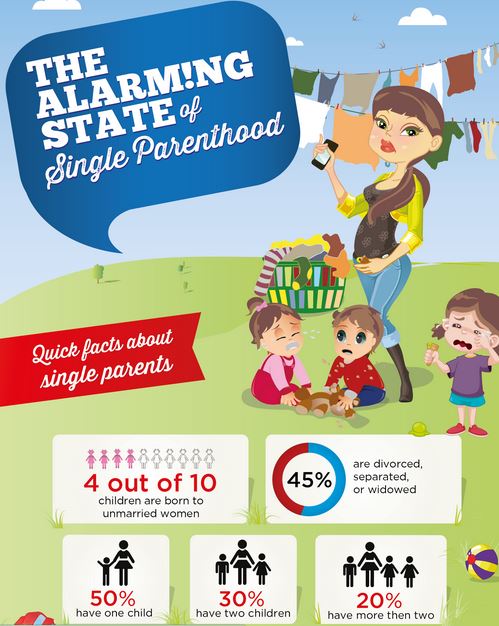
And it is precisely because they chose those words that I know race plays a significant part in why Adrian Peterson’s tragedy is now his trial. Black America’s “Daddy Problem” has been spoken about by everyone from Don Lemon to Rush Limbaugh, from Bill Cosby to President Obama. Cultural pundits turn the infamous 70% out-of-wedlock black births statistic inside out to either prove the decline or normalcy of Black America.

AP is simply another baby daddy to many of them, progenitor of another batch of fatherless black kids to incarcerate later. He is archetype, arch villain. No one bothers to dig deeper. Instead, Peterson–and other black men like him–are blacklisted as pathologically randy men who cannot keep it in their pants.

The familiar stats on single parenthood. (Photo Credit: Tomica Bonner)

Make no mistake: this is not a defense of AP’s character, which honestly, I can’t speak on. Rather, I am upset that critics see fit to paint him monstrous and unfeeling, a rutting beast of sorts, unworthy of simple human sympathy at the death of a child. AP doesn’t know how to find a condom? AP has sex with strippers?! He should be better than that. The only thing I know for sure about AP is that he is human.

I will attribute part of the moral superiority to the culture of celebrity watching, which seeks to simultaneously sketch celebs as “just like us” and “freakish people.” AP is worthy of praise so long as he is using his freakishly talented black body to garner points for fantasy football teams and money for billionaires. Regardless, Peterson can grieve the loss of a child he barely knew, just as a parent can grieve the loss of a baby that did not live to full term.

Let detractors flap their gums and caw their displeasure at the alleged seven children Adrian Peterson fathered. I admonish them to remember that October is Domestic Violence Awareness Month and that an innocent boy has sadly demonstrated the need for such awareness. The specter of murderous perpetrators–of whatever race–is far more monstrous than any caricature of a black man they could paint. May Peterson grieve in peace.