Decoding Ratchets, Respectability, and Racism

Species: Ratcheticus. Genus: Ghettonicus

I think of the word ratchet like a friend you graciously let stay on your couch: it was cool at the beginning, but it’s really overstayed its welcome by about a year.

The first time I heard the word was in a 2009 song by Hurricane Chris called “Halle Berry (She Fine),” where the rapper drones, “Well, let’s get ratcheeet, let’s get ratchet!” I didn’t know it at the time, but ratchet was originally a genre of crunk rap music local to Shreveport, Louisiana, where Hurricane Chris originates.

My first reaction was, “What does ratchet mean?!” But the answer I would have received then is not the answer I’d get in 2013. Ratchet has flown far from the swamps of Shreveport into its own murky national definition. The word has adopted the negative class implications of ‘ghetto’; in fact, I think ratchet has deep-sixed ghetto out of popular black vernacular.

More and more, however, I have seen the evolution of the word as a gender-specific descriptor for black women. “Ratchets,” a noun in the plural sense, rarely applies to men (not to be confused with the verb “ratchet,” which derives from the tool of the same name). In this case, the definition morphs into a woman whose priorities are upside down and whose antics are over the top. See: “She Ratchet.”

But ratchet/ratchetness also occupies a unique space in black culture. On Facebook, I see old college friends assign their love for the Basketball Wives or Love and Hip-Hop franchises to their ‘ratchet sides,’ or conversations dubbed “sophistiratchet.” In this sense, the word connotes a low-brow factor to entertainment. Young black people still want to have a ‘ratchet side’ while maintaining an air of polish (i.e. code switching).

It was okay to be ratchet until the Twerk Heard ‘Round the World at the VMAs. All of a sudden, I saw people distance themselves. “Oh, Miley Cyrus only imitated the ratchet part of black culture,” “Twerking isn’t blackness,” “Only ratchet women twerk anyway; it’s disgusting!” As if twerking was never done by anyone with a degree.

The respectability police came out with batons, beating down the image of ratchetness as antithetical to black progress. My problem with this stems from the spectator sport that occurs when people engage in a culture but place themselves above it. Yeah, I watch twerk videos on WorldStar, but I’m not like those ratchets! Or: Yes, I twerk/rap, but I’m white and can go back to ‘normal’ at any time. 

Patently untrue; I have found tumbleweave in the suburbs! Exhibit A: Ratchet class bias.

Much has been said lately about respectability politics, which posit that black people can improve their lot in life by just cleaning up their image. Tricky. Certainly, not twerking or sagging your pants in public may help society think better of you, but it doesn’t mean they will treat you better. I advocate for people to be the best they can be regardless.

I realized recently that what I want is white privilege. No one made parallels linking Miley Cyrus’ teddy bear onesie stunt to the future of white American tweenyboppers. But I had vehement debates with friends about whether or not the questionable activities of some black people will sink the entire race.

Will our collective negative image to white America be our communal downfall?

I want the liberty for some black people to be mediocre, if they so choose. I want there to be wine-up dance videos on YouTube and Essence spreads on Shonda Rimes because black folk are not a monolith and we deserve the right to be human, not 100% model minority figures. 

Because the truth of it is this: If Martin Luther King, Jr. was not enough, if Paul Robeson was not enough, if Toni Morrison was not enough, if Frederick Douglass was not enough, if Mary MacLeod Bethune was not enough to prove that black people are worthy of dignified treatment (by the logic of respectability politics), we will never end racism.


One Less Crab in the Barrel

“He Ain’t Heavy” by Gilbert Young

Over the years, I’ve come to realize that an aphorism is the particle board of conversation: cheap and easy to drill holes through. They hold no weight, and when challenged, the trite words collapse as if we never meant them at all.

Like many linguistic tools, aphorisms are best used with care instead of being misapplied to situations that often do not fit.

This crossed my mind when thinking of the phrase “crabs in a barrel.” The visceral image is one of crabs sitting in a pot waiting to be cooked, with an ambitious crab doing his best to head upward toward freedom and his compatriots yanking him down with their claws. No one escapes the pot; they all get served up steaming hot.

I often hear the phrase in reference to minorities not giving back to their respective communities. We can’t get ahead because of the crabs in a barrel mentality that pits brother against brother and makes them believe, erroneously, that they are enemies. I have subscribed to this theory, have theoretically admonished people for failing to work collectively toward a common goal.

But what do you do if a common goal becomes a conflict of self-interest?

A friend of mine relayed a quandary she is facing. Through some research, she discovered a professional opportunity with a short application window. There are several other colleagues with whom she interacts daily, who could potentially benefit from this opening. However, it’s highly competitive. They are colleagues in a field with few minorities and minorities are often overlooked because of social networking deficiencies, which makes landing that coveted spot even more difficult.

She asked me, “Would I be wrong for not mentioning this opportunity to my friends and coworkers? It would be weird seeing them daily and omitting the fact that I’m waiting to hear back from this great position I applied for.”

On the other hand, informing her coworkers would be tantamount to increasing the competition pool. What happens in the event you compete for a great job with a friend and one of you actually gets it?

I thought long and hard. Finally, I advised her to keep her application confidential, but pass along any opportunities she hears about to her colleagues.

Some might say that not sharing any and all information makes my friend that proverbial crab. But I disagree. You have a better advantage in helping someone up if you are already there yourself. I’m confident that if my friend earns this slot, she’ll do her absolute best to smooth the pathway for others to come behind her.

Because as long as you don’t advance on the backs of the other crabs, there’s absolutely nothing wrong with being one less crab stuck in the barrel.

Do you think I gave her good advice? What would you have said?

Happy NFL Kickoff Day! Go Bucs!

Happy NFL Kickoff Day! Go Bucs!

In case there was any doubt, let me state my allegiance now:

I hail from the land of palm trees and cool breezes,
the land where we be free from winter’s freeze
where sunshine appears all four seasons
home of Gasparilla and Cuban sandwiches
Ybor’s cigars and hurricane damages
where pewter pirates pillage defenses
and shoot canons
so don’t ask where my allegiance is
Florida to Georgia transplanted but I rep

THEM TAMPA BAY BUCCANEERS!

Parkinson’s: Stealing from Grandma

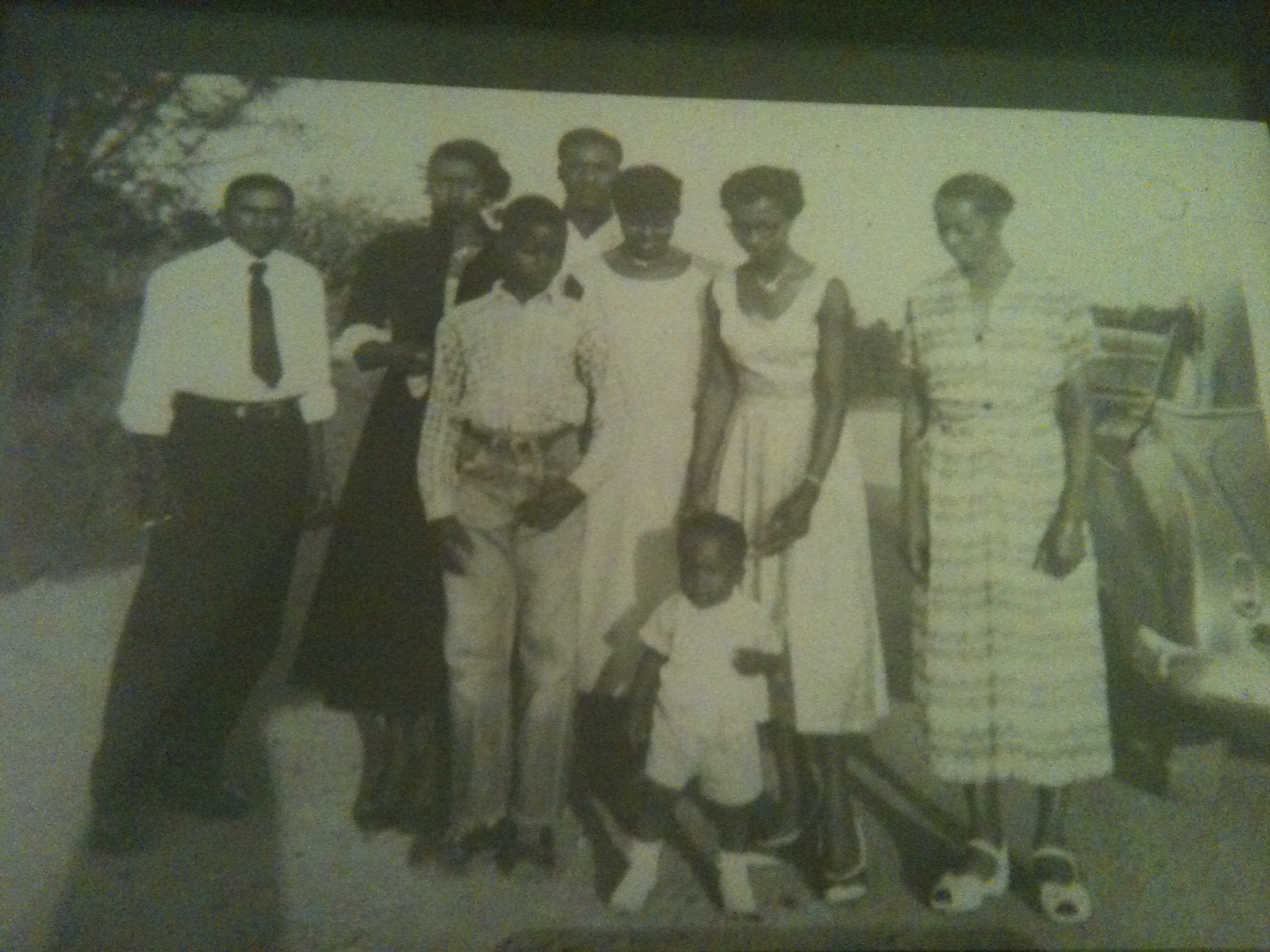
My great-grandmother, grandmother, and me

I began stealing from my grandma three years ago.  When I realized that one day I would not be able to wake up and find her sitting in the kitchen, watching a 13-inch black-and-white television, I needed something concrete.  I needed something tangible to slow the slide of time that had pushed, like a loose fader, loudly past me.

On a visit to see her in 2010, I idly rifled through a drawer in the nightstand next to my bed. A photo, forgotten, peeked from underneath a hodgepodge of pincushions and papers.  It was too dope, from what had to be the late 1950s.  A toddler in Little Lord Fauntleroy shorts, my father stood in the foreground, flanked by his mother, his grandmother, and other dapper-don Negroes.  One short fellow was dressed in black pants firmly belted to mid-waist, constrained with a necktie, gangster leaning. Were they coming from church? Only an expanse of sky and grass bracketed the figures, who stood next to a classic car.  No one smiled.

I grinned.  There was an original and a copy.  Pausing, I snatched up the copy and slid it into a notebook in my purse.  Back in Georgia, I dusted off an unused shadow box frame, folded some single-side tape to double stick, and put it on display. There, there was proof that my grandmother, lithe and coiffed, was more than the shell that Parkinson’s Disease rattled continually.

Parkinson’s is a debilitating snowball of symptoms, a prolonged dance with alternately stiff and tremulous limbs. I wonder now how long I didn’t notice, how long I mistook the slow degradation of nerve cells as an uncharacteristic clumsiness. Grandma Lennye’s fingers, a golden honey-tone, always had grace to them.  My grandmother is now a body of earthquakes, a rumbling of muscle into ligament and unsettled cells. Her arm shakes like a tympanic break beat mid-symphony, a dub step piece sampling groove and funk battling dyskinesia at dinner.

The disease has stolen her voice. Conversation is difficult as her tongue jerks, swallowing sound: her mouth is a prison of teeth where words crumble into grunts. I sort through the rubble of her speech to make treasures of broken language, tuck them into my eardrum and replay. Try as I might, I cannot understand her.

My family in Alabama, probably late 40s or early 50s.
My family in Alabama, probably late 50s. My father, the toddler, looks like he might bolt.

The picture I swiped sits on my work desk to remind me that my history is ever before me. I wish time had shaken me instead and pushed me to ask her about King and Detroit when it was beautiful and black-and-white pictures that are only in color as she remembers them. Her legacy I never thought of in youth. Of all the things Parkinson’s has pilfered from her, I miss her conversation most. The next time I visit, I take her registration slip from Alabama State College for Negroes and hope it tells the story she can’t anymore.

The phone unsettles me each time it rings with my father’s name on the screen. I expect bad news. The tremors have shaken the foundation of my grandmother’s soul looser from the earthen vessel it rests in. Hospice care means she will be comfortable, but my emotions toss to and fro thinking that I am waiting for her to slip away. Days etch into months, borrowed squares on the calendar. I pray for healing but know she will never be still again, in this life.

So, there it is. I have stolen her pictures and papers as thin comfort, because I cannot hold my grandmother tight enough to stop her from shaking, to steady my world from the quake her absence will bring me.

Social Media and the Unfollow Button

Facebook logo Español: Logotipo de Facebook Fr...
MySpace Who?!

Over the past year, I joined a slew of social media networks: Instagram, Twitter, Tumblr, Pinterest, LinkedIn, and WordPress. I’ve long been a Facebook junkie but was reluctant to spread the love to other sites.  I run the risk of alienating the real people in the room with me when I delve into my screens. But a wise woman (my mama) told me that I should network more, and so I signed up.

Being the new kid on the block has a short learning curve. This is no country for people who don’t know how to use Twitter. I swing from being too bashful to tweet Famous People, to having Elon James White Storify a tweet I wrote, to utterly embarrassing myself by misquoting Destiny’s Child’s “Bug A Boo” to an editor at TheRoot.com. Oh. The Horror.

Ehrmagerd. I blush afresh.

I have a humble 87 followers on Twitter. Whenever a message hits my email inbox, a current runs through my big toe. Yay! You have a new follower on Twitter! Yo, Dara, so-and-so is now following your Tumblr blog; do a Dougie. And I do! (Okay, not really. No one ever taught me how to Dougie).

It struck me the other day, as I pondered my fluctuating number of Twitter followers, that no social media site sends announcements for unfollows (by the way, is this a verb yet?). Are we not supposed to notice? Or am I the only one who feels a teensy ‘whomp whomp’ when my follow count slides closer to zero?  Granted, email notifications for losing followers probably wouldn’t go over well.

You lost two followers today, Dara; just quit already.

So-and-so dropped your Tumblr blog today because you were boring.

You call this tweeting?! Your lost followers didn’t think so, either.

There is no dedicated “unfollow” button, is there? You simply hover over the friendly button that says “Following” and it changes to an angry red “Unfollow.” Following is so impersonal (no intros needed, you just up and add folk to your timeline without so much as an “I like your tweet steelo”), so it makes sense that unfollowing is even more so.

I am a student of workshops; feedback is paramount. I struggle to navigate the impersonal nature of social media, which asks that you engage and be engaging, without the pleasantries required in real life. Sometimes I do wonder why my followers jump off. And since few sites tell you who left the fold, I think about that, too. I don’t go so far as to investigate, because, you know, that would be crazy. I know that social media etiquette dictates announcing an unfollow, especially on Facebook, is a weaksauce move.

But it would be nice if social media was, um, sociable enough to include a button for you to tell people why their Instagram feed got on your nerves (i.e. too many seatbelt selfies). It would help the noobs be less #Twitterdumb!

What makes you unfollow people? Do you care why people unfollow you?